
Gold Card Voice & Tone
Building a voice system and a seat at the table—from copy support to strategic partner.
Overview
After Robinhood's acquisition of X1, the Gold Card entered Robinhood's product ecosystem as a premium credit card with 3% cash back, exclusive benefits, and a separate app experience.
When I joined as the team's first embedded Content Designer, two gaps became clear: the Gold Card's existing infrastructure lacked a cohesive voice strategy, and content design was treated as a late-stage polish layer rather than a strategic partner.
My goals were twofold: define a scalable voice and tone system for the Gold Card, and demonstrate how content could improve user trust, reduce friction, and influence product decisions.
My role
- First embedded Content Designer on the Gold Card team
- Led end-to-end content audit of the live experience
- Created Gold Card voice, tone, and grammar standards
- Rewrote onboarding and key product surfaces
- Partnered with Product, Design, and leadership on messaging strategy
The Challenge: Redefining Premium
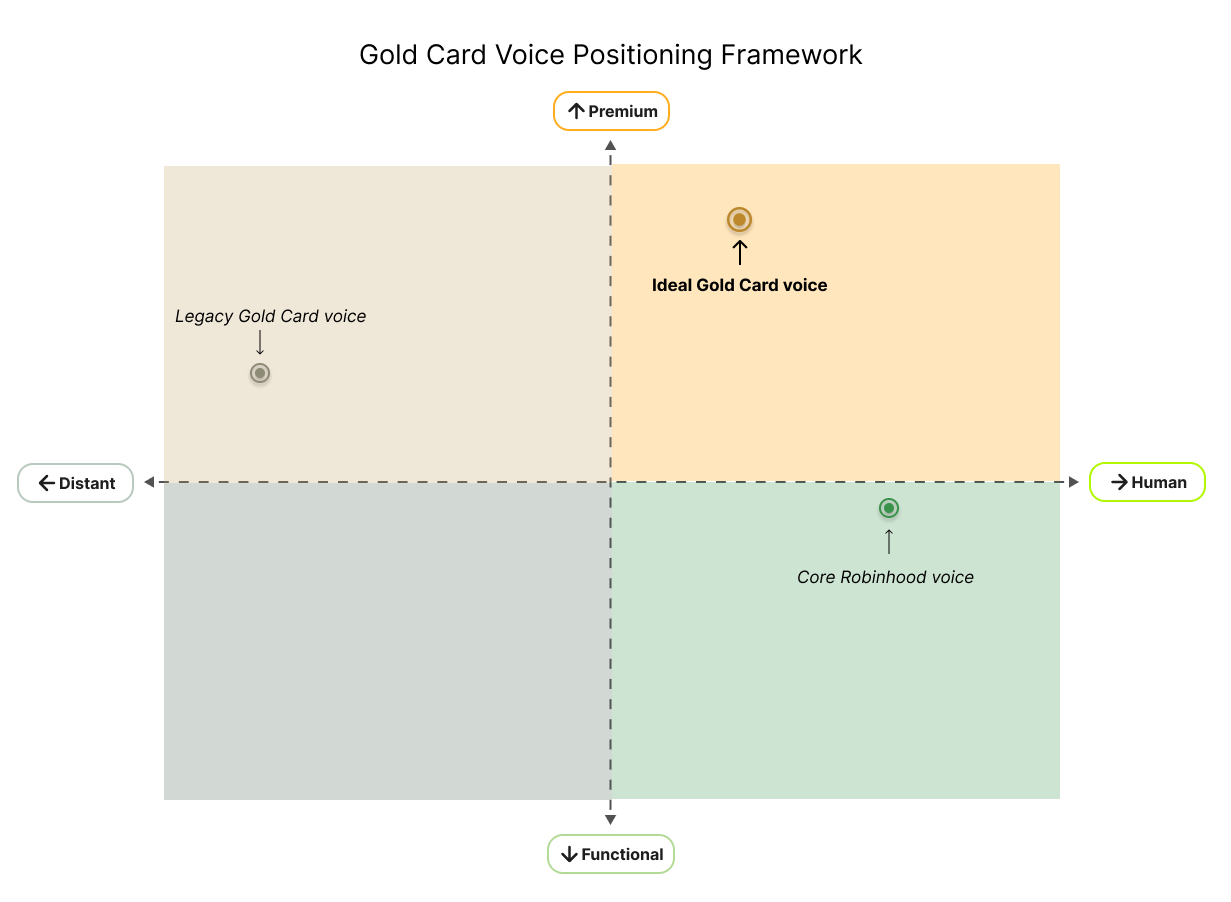
The Gold Card's legacy voice wasn't built under Robinhood's content standards.
Robinhood's brand voice is approachable, conversational, and human. The Gold Card, meanwhile, was being shaped around lofty descriptors like white-glove and luxury—but without a shared understanding of how those qualities translated in language.
In practice, "premium" had become shorthand for formal. This assumption showed up across the experience: dense, passive language created friction at high-stakes moments, especially onboarding, where users were asked for sensitive information without enough context.
This revealed the central challenge: How do you make a financial product feel elevated without sacrificing warmth, clarity, or trust?
I landed on an insight that shaped my path forward: Premium doesn't mean formal—it means intentional.
Premium experiences don't feel elevated because they sound stuffy. It's because every detail feels deliberate: clear when stakes are high, restrained when simplicity is needed, and aspirational when emotion matters.
Audit: Diagnosing the Problem
Rather than immediately rewriting screens, I audited the full live experience to identify where language was creating friction. Three patterns emerged—especially visible in onboarding.
| Pattern | Symptom | User impact | Content solution |
|---|---|---|---|
| Overly formal, dry language | Dense legal phrasing, lengthy and vague CTAs | Reduced understanding and trust | Reframe with confidence and brevity |
| Weak information hierarchy | Passive voice created unclear ownership of action | Increased cognitive load in high-stakes flows | Make ownership clear with active voice |
| Friction and dead ends | Unhappy paths lacked clarity—recovery paths were unclear | Higher frustration and drop-off in sensitive moments | Provide context and next steps when questions arise |
Building a Shared Language
A major challenge: feedback around content was highly subjective. Conversations often sounded like "make this more premium" or "more white-glove" without clear criteria for decision-making.
To solve this, I created a Gold Card content standards framework that translated abstract taste into actionable guidance and gave the team shared language for evaluating tradeoffs.
The voice system centered around three principles:
- Premium, not pretentious: elevated but not exclusionary.
- Confident, not cold: channeling high-end concierge energy.
- Clear and concise, above all: in financial contexts, clarity is king.
I also adapted Robinhood's broader editorial standards—including active voice, grammar, and readability guidance—to ensure Gold Card maintained consistency with the larger product ecosystem.
This shifted content discussions away from personal preference and towards clearer, more intentional decisions.
Reducing Friction in High-Stakes Moments
One of the largest onboarding drop-off points occurred when users were asked to provide their Social Security number.
The screen requested highly sensitive information without clearly answering the questions users actually cared about: Why do you need this? Will you conduct a hard pull on my credit? What happens next?
I introduced lightweight disclosure content explaining that Robinhood would use the SSN to perform a soft pull of the user's credit report and verify their identity, along with clear expectations of the timeline for next steps.
Users are far more willing to share sensitive information when they understand why it's needed and what happens next. In high-stakes financial flows, clarity is one of the strongest trust signals you can offer.
This small content change decreased ambiguity at a psychologically sensitive moment and helped reduce onboarding drop-off after launch.
Earning a Seat at the Table
My manager and I initiated this audit proactively to challenge the team's existing mental model of content as late-stage execution, and to demonstrate content's end-to-end impact on UX, trust, and conversion.
A turning point came when leadership reviewed my onboarding audit and approved the proposed changes in full.
The shift became most visible in live messaging workshops. Instead of bringing me in late to refine microcopy, leadership began inviting me to pressure-test messaging directions in real time—using content to shape decisions instead of polishing them.
The voice framework continued to be used after my move to a different team, and later helped inform foundational messaging for Robinhood Banking.
Reflection
This project reinforced something I still believe deeply: content design is rarely just about the words on a screen. Done well, it shapes how teams think, how products build trust, and how strategy becomes tangible in the user experience.